Two shores, many beginnings
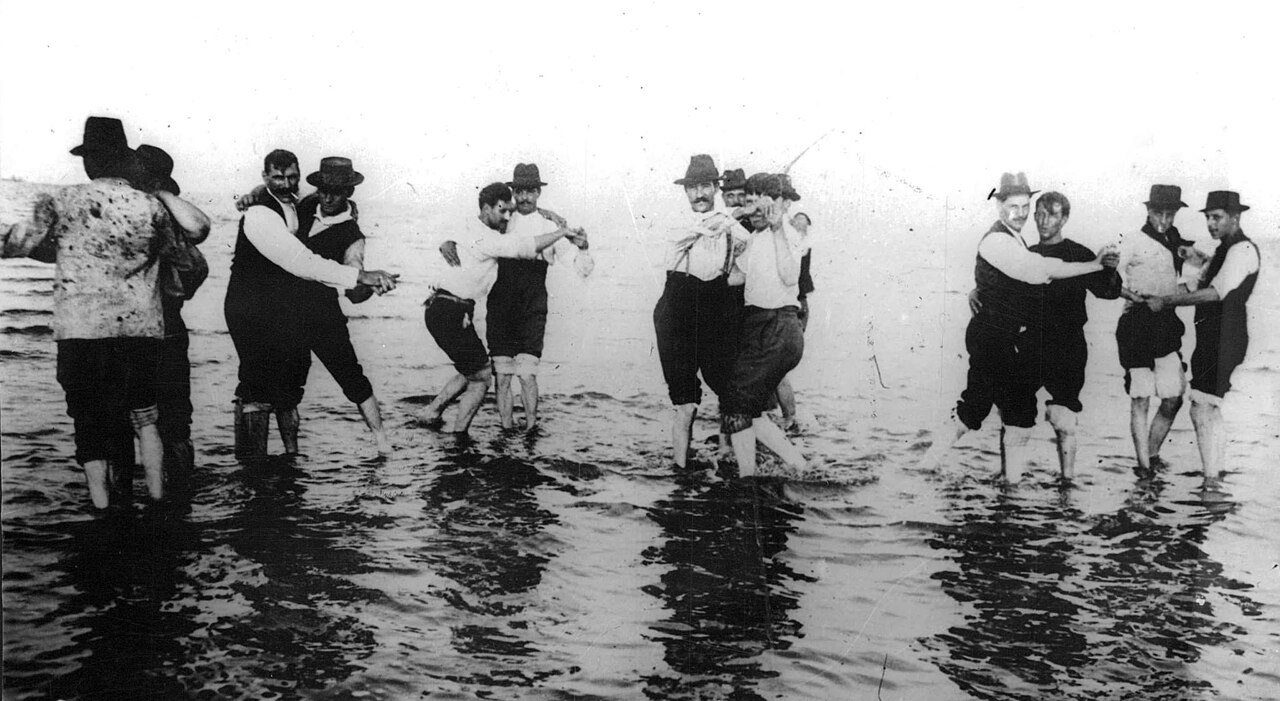
Tango took shape around the Río de la Plata, especially in the working-class worlds of Buenos Aires and Montevideo. Ports, migration and expanding cities brought people into contact: Afro-descendant communities, locally born criollos and immigrants with different musical and social traditions. The result was a developing culture of music, dance and words rather than a single invention on a known day.
Historians disagree about precise beginnings and the weight of particular influences. Stories that locate everything in one brothel, one neighborhood or one national genius compress a much wider social history. Early records are uneven, and later memories often carry the values of the people telling them. It is more useful to follow overlapping communities and practices than to look for a lone inventor.
READ THE SOURCES UNESCO ↗Omar García Brunelli, Oxford Bibliographies in Music ↗
African contributions belong in the story
African and Afro-descendant contributions are fundamental to understanding tango. Research from Argentina’s national musicology institute challenges histories that made Black musicians and communities disappear from the narrative. Pianist and composer Rosendo Mendizábal, associated with El entrerriano in 1897, and guitarists José Ricardo and Guillermo Barbieri are among the figures who make that erasure impossible to sustain.
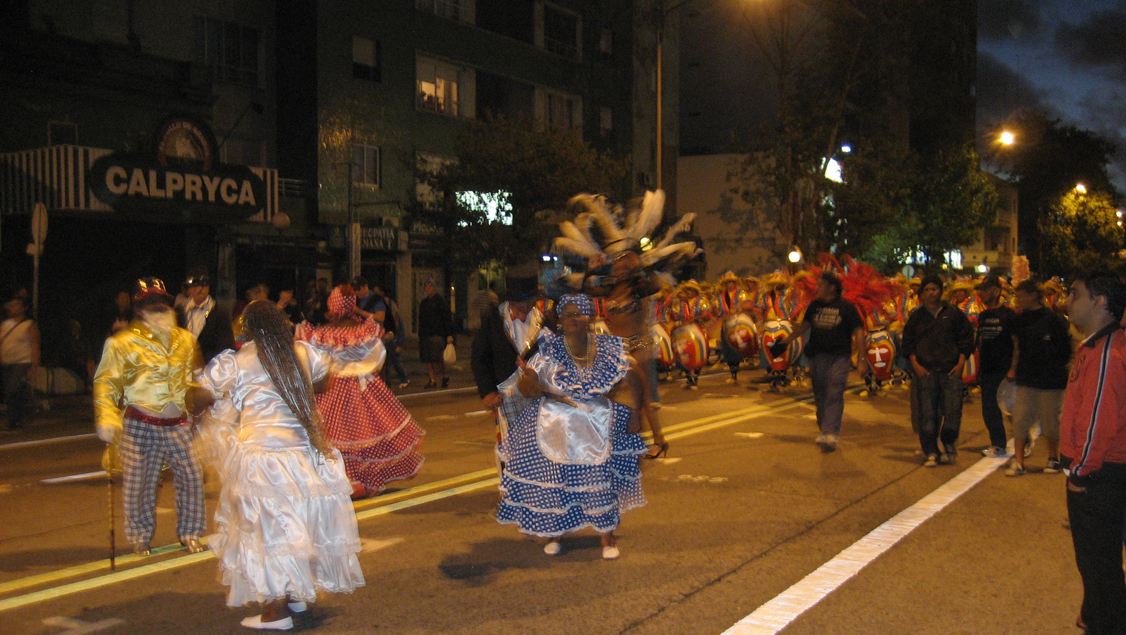
Candombe, habanera and milonga are important to the wider musical landscape around tango, but they are not interchangeable names for the same music. Candombe remains a distinct Afro-Uruguayan tradition with its own communities and history. A modern photograph of its drummers helps show a living cultural world; it cannot document exactly how a nineteenth-century tango sounded. The documentary Tango Negro explores these questions through music and interviews.
READ THE SOURCES Argentina, Secretaría de Cultura / Instituto Nacional de Musicología ↗Comisión UNESCO Uruguay ↗
The Old Guard finds a sound
The period commonly called the Guardia Vieja, or Old Guard, saw tango become recognizable through compositions, performers and dance practices. Early groups could include flute, violin and guitar. As ensembles changed, the bandoneon became increasingly important. Musicians such as Roberto Firpo and Francisco Canaro helped build a repertoire that later players would repeatedly reinterpret.
The borders between historical periods are approximate. A name such as Old Guard is a useful listening guide, not a switch that every musician flipped in the same year. Written scores, recordings and oral transmission each preserve different parts of the music. Comparing performances of the same tune can reveal how much an arrangement, a singer or a change of instrumentation transforms what dancers hear.
READ THE SOURCES Government of the City of Buenos Aires ↗Omar García Brunelli, The Cambridge Companion to Tango ↗
The voice of the bandoneon
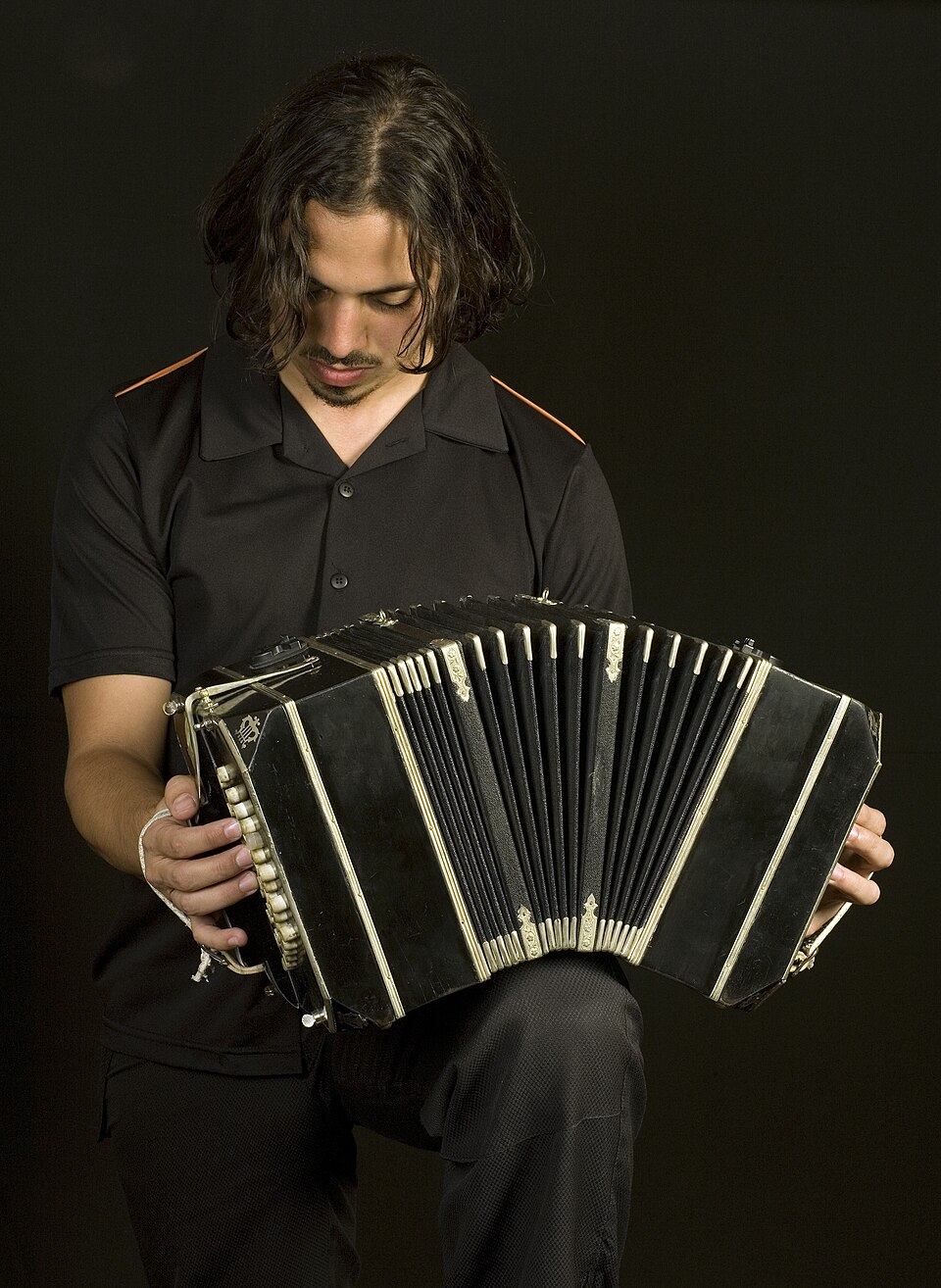
The bandoneon is a bellows-driven free-reed instrument related to the concertina. Developed in Germany, it became closely associated with tango after crossing the Atlantic. Its adoption is a reminder that a cultural emblem can have a history of migration of its own: an imported instrument acquired a new expressive life in the Río de la Plata.
The performer controls air through the bellows while working buttons on both sides. Sustained notes, attacks, changes of pressure and breathing-like phrases make the player’s choices audible. In tango, the instrument can sing a melody, answer another section or contribute to the rhythmic force of an ensemble. The modern photograph here shows Matías Rubino playing in 2006; it illustrates the instrument, not its first arrival.
READ THE SOURCES Smithsonian Music / National Museum of American History ↗
Tango travels—and changes as it travels
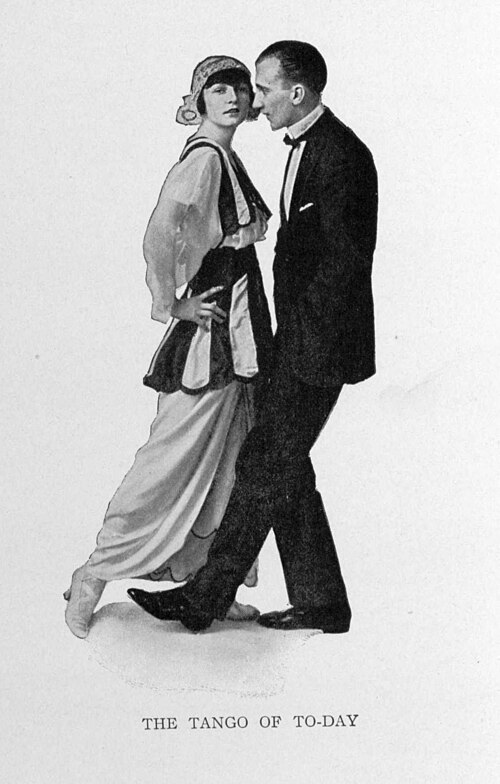
Tango’s international story began well before today’s festivals. By the early twentieth century, overseas enthusiasm was turning it into a fashionable dance as well as a subject of anxiety about bodies, manners and respectability. The transatlantic journey did not simply reproduce a single original: teachers and performers adapted movement to new audiences and social expectations.
Vernon and Irene Castle’s Modern Dancing, published in New York in 1914, is a revealing primary source. Its tango descriptions appear alongside advice about clothing, grace and etiquette. The book shows how one influential couple taught and presented the dance; it should not be mistaken for a neutral record of every Río de la Plata dance floor. Later ballroom tango traditions and Argentine social tango belong to related histories, with different conventions and techniques.
READ THE SOURCES Library of Congress, Music Division ↗Omar García Brunelli, The Cambridge Companion to Tango ↗
A song, a voice and a tango from Montevideo
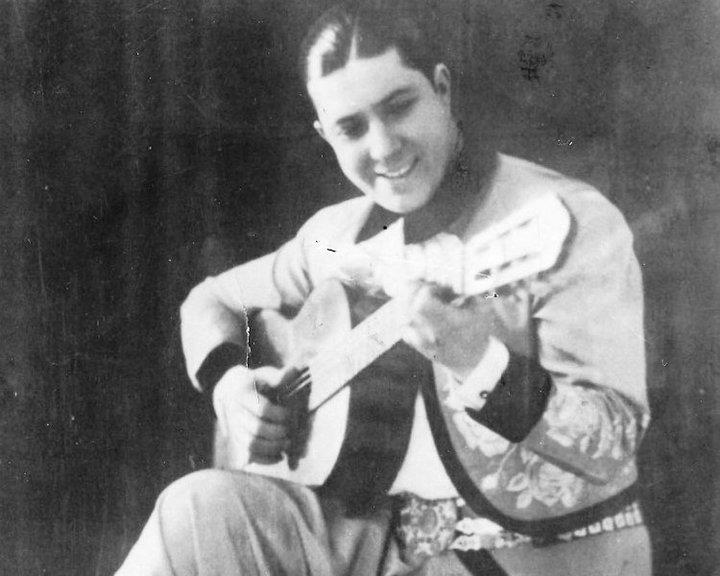
Carlos Gardel’s 1917 interpretation of Mi noche triste became a landmark of tango canción. Pascual Contursi’s words were set to Samuel Castriota’s music, previously known as Lita. The importance of the song lies in the way a personal, urban story could inhabit the musical phrase. It helped establish a powerful model for the tango singer, without meaning that no one had sung tango before.
Across the river, Gerardo Matos Rodríguez’s La Cumparsita entered the public story of Montevideo. Uruguay commemorates its first performance at the café La Giralda on April 19, 1917. It would become one of tango’s most recognizable works. These two histories show why neither a singer’s fame nor the reach of one city can stand in for the shared cultural life of the region.
Recordings and cinema helped carry voices beyond the room in which they performed. Gardel’s lasting reputation is inseparable from that circulation. Yet tango canción remained a collaborative art: composers, lyricists, guitarists, arrangers and interpreters all shaped what a listener could hear in a few minutes.
READ THE SOURCES Fundación Internacional Carlos Gardel ↗Museo Casa Carlos Gardel, Buenos Aires ↗Presidencia Uruguay ↗
The New Guard reshapes the orchestra
The Guardia Nueva, or New Guard, brought increasingly elaborate ensemble writing and new expressive possibilities. Sextets associated with figures such as Julio De Caro and Juan Carlos Cobián belong to this transformation. Bandoneons, violins, piano and double bass offered contrasting colors, stronger ensemble textures and room for individual phrasing.
An orchestra’s identity is more than the tune it plays. Arrangements distribute melody and accompaniment, create tension between sections and decide where the rhythm is stated or suspended. Singers and instrumentalists negotiate those choices together. This is why dancers often recognize an orchestra’s character before identifying a composition—and why learning the orchestra names opens a richer way into tango history.
READ THE SOURCES Government of the City of Buenos Aires ↗Kacey Link and Kristin Wendland, Oxford University Press ↗
Women helped make tango
A history centered only on male bandleaders and one famous singer leaves out essential creators. Azucena Maizani was a singer, composer and lyricist whose work expanded the possibilities available to women in tango. Her performances also unsettled expectations about presentation: Argentina’s cultural biography recalls her use of clothing associated with men and gauchos.
Her example invites a broader question whenever we encounter an archive: whose work was recorded, credited and preserved? Performers can be visible on a stage while the decisions they made disappear from later accounts. Reading biographies alongside recordings, photographs and testimony makes space for artistry that a simple list of famous men would miss. In the film Our Last Tango, María Nieves’s recollections offer another route into a woman’s experience of a celebrated performance partnership.
READ THE SOURCES Argentina, Secretaría de Cultura ↗
Watch the official Our Last Tango trailer ↗The orchestra becomes a social world
The decades usually gathered under the name Golden Age were a high point for tango orchestras and dancing. The 1940s in particular brought a dense world of performances, records and popular culture. Names such as Juan D’Arienzo, Carlos Di Sarli, Aníbal Troilo and Osvaldo Pugliese refer to distinct musical approaches rather than interchangeable versions of a single sound.
Listen for where an orchestra places its rhythmic weight, how a phrase stretches and how the singer enters or leaves the instrumental texture. A tune can feel dramatically different in two arrangements. Those differences are part of the conversation between musicians and dancers, who respond through walking, pauses, turns and changes of energy.
Golden Age is a period label, not a claim that later music is less valuable. The documentary Café de los Maestros returns to veteran musicians and their craft, while Si sos brujo follows the work of passing orchestral knowledge to younger players. Together they connect celebrated recordings to the people and teaching practices behind them.
READ THE SOURCES Kacey Link and Kristin Wendland, Oxford University Press ↗Government of the City of Buenos Aires ↗
Piazzolla opens another musical door
Astor Piazzolla developed a concert-oriented language that brought tango into dialogue with classical composition, jazz and experimentation. His studies with Nadia Boulanger in Paris in 1954 were an important turning point. The result was not simply a faster or more difficult version of the dance-band repertoire, but a different set of possibilities for composing and listening.
His work provoked arguments about what could still be called tango. That disagreement is itself part of the history: traditions change through musicians who reinterpret their inheritance. Nuevo tango in this musical sense should not automatically be equated with every dance practice later called tango nuevo. A composition, a teaching method and a social dance label can share a word without describing the same thing. Piazzolla: The Years of the Shark explores the musician through family and archival material.
READ THE SOURCES Argentina, Secretaría de Cultura ↗
A stage revival meets the social floor
The show Tango Argentino, created by Claudio Segovia and Héctor Orezzoli, opened in Paris in 1983 and became a landmark in tango’s international visibility. Its touring world brought dancing, singing and orchestras to audiences who might never have attended a milonga. Stage artists helped inspire a new public to seek out the dance.
A theater audience and a social floor ask different things of a dancer. Performance can use rehearsed choreography and a presentation designed to be seen from a distance. Social tango is built around responding to a partner, the music and other couples sharing limited space. Interest generated by a show can lead someone into classes, but the floor has its own learning process. Oral histories of Buenos Aires milongas preserve the memories, disagreements and practical knowledge involved in that transmission.
READ THE SOURCES Argentina, Centro Cultural Borges ↗Buenos Aires, Comisión para la Preservación del Patrimonio Histórico Cultural ↗
Inside the milonga
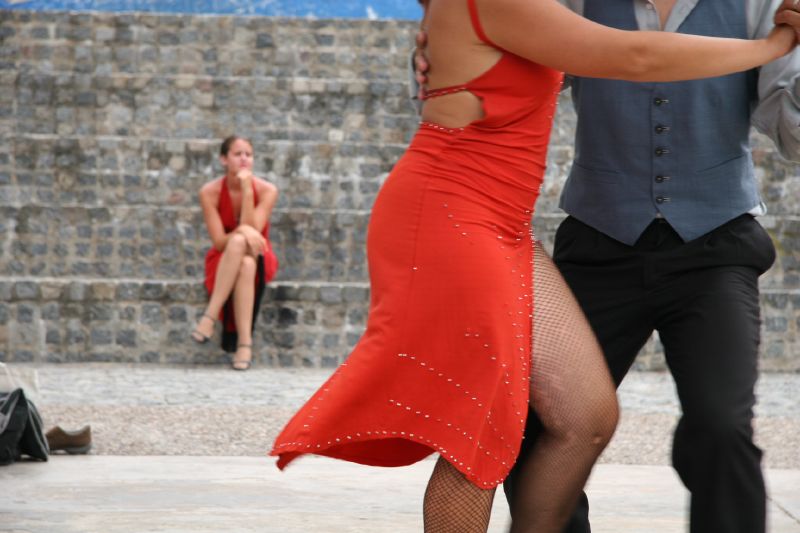
Milonga has more than one meaning: it can name a musical genre and the social gathering where people dance. A night may include tango, vals and milonga music. The event is also a small social world, shaped by organizers, musicians or DJs, teachers, regulars and visitors. The embrace and the ability to move with others matter as much as the figures a dancer knows.
Many gatherings organize music in tandas, or sets, with short cortinas between them. Customs around invitation, changing partners and circulating around the room vary. An unfamiliar venue is a place to observe and ask, rather than assume that one city’s habits apply everywhere. A práctica is generally a setting for working on the dance, while a class gives structured instruction.
Buenos Aires’s heritage inventory recognizes social milonguero dancing, and its cultural-venue regulation explicitly describes tango, milonga, vals, tandas and cortinas. These documents help show that the social infrastructure is part of the culture. They are useful historical and institutional sources, not a universal rulebook for every gathering in the world.
READ THE SOURCES Argentina, inventory of intangible cultural heritage ↗Boletín Oficial, City of Buenos Aires ↗Buenos Aires, Comisión para la Preservación del Patrimonio Histórico Cultural ↗
A living tradition keeps asking questions
Electronic projects and new acoustic ensembles have expanded tango’s sound, while many dancers continue to explore older recordings. Different generations often share the same music without sharing a single idea of authenticity. Keeping a tradition alive can mean studying an arrangement closely, composing something new, teaching a beginner or sustaining an ordinary weekly gathering.
Queer tango practitioners have also challenged the assumption that dance roles must be assigned by gender. Mariana Docampo’s founding statement describes a space for exploration and the exchange of roles. This is a practitioner’s perspective within a wider, varied tango world. It invites us to see leading and following as skills people learn, and to ask who feels welcome on a particular floor.
In 2009 UNESCO inscribed tango on the Representative List of the Intangible Cultural Heritage of Humanity through a joint Argentina–Uruguay nomination. Recognition concerns a living community of music, dance and poetry, not a finished museum object. The ongoing work belongs to the people who make, transmit and adapt it.
READ THE SOURCES Government of the City of Buenos Aires ↗The Queer Tango Project / Mariana Docampo ↗UNESCO ↗
Use the history when you listen and dance
Start with a few contrasts: an early instrumental tango, a Gardel song, several orchestras from the 1940s and a Piazzolla composition. Listen to the same piece in more than one version. Notice whether the melody is carried by a voice, a bandoneon or the ensemble, and whether the pulse feels direct, elastic or interrupted.
Then connect listening to context. A film about a stage partnership answers different questions from a documentary about an orchestra school. A modern street photograph cannot show a nineteenth-century dance floor, and an old manual records its author’s approach rather than every dancer’s experience. The linked archives, biographies and films let you compare those viewpoints.
The directory is the next step from reading to meeting the culture. Explore Argentina and Uruguay, or look for a local school, community or milonga. Follow each listing’s sources, check its current schedule and keep historical appearances distinct from a provider’s present location. Tango’s history continues in the ordinary act of people choosing to dance together.
The language of the floor.
- Abrazo
- The embrace or dance hold; its shape and closeness vary with partners, space and approach.
- Bandoneon
- A bellows-driven, button-operated free-reed instrument central to many tango ensembles.
- Milonga
- Both a musical genre and a social dance gathering; context tells you which meaning is intended.
- Vals
- Waltz music within the tango repertoire, with a three-beat meter.
- Tanda / cortina
- A set of dances / a short musical interlude separating sets at many social events.
- Orquesta típica
- A tango ensemble traditionally built around bandoneons, strings, piano and double bass; size and instrumentation vary.
- Pista / escenario
- The social dance floor / the stage. Competition categories use these labels but do not define every social style.
- Guardia Vieja / Guardia Nueva
- Old Guard / New Guard: approximate historical period labels, not rigid dates or quality rankings.
MORE CONTEXT Buenos Aires venue terminology ↗Research on vals criollo ↗Pista and Escenario competition categories ↗